A minimum setup for planning?
Read more
Fast, good and cheap – choose any two.
Or, according to another source (more about the sources):
SPEED, QUALITY, PRICE – Pick any Two
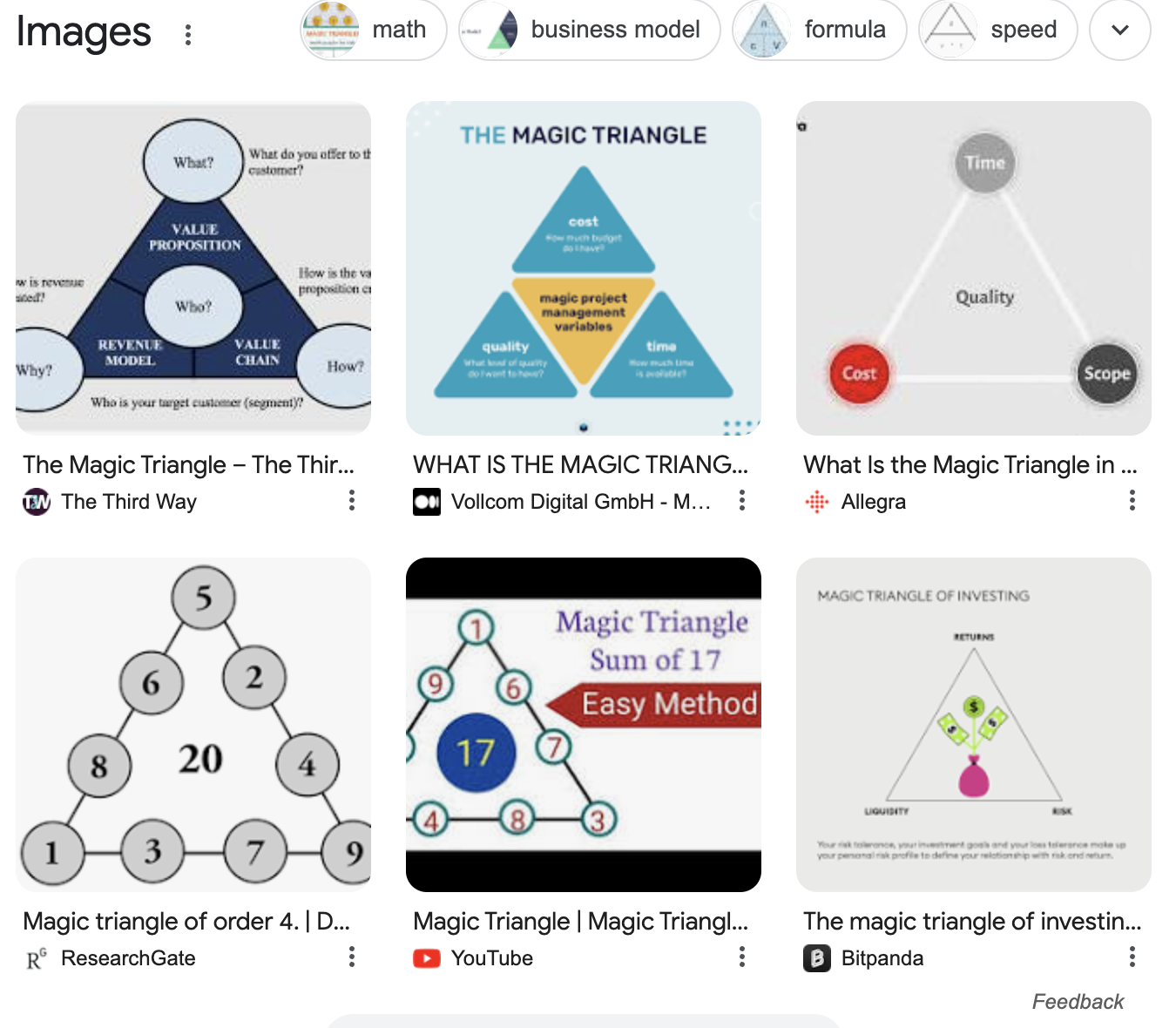
As a quick search on Wikipedia will point out a somewhat more appropriate name seems to be "project management triangle", but still, with all the ambiguity of the term “magic triangle”, many people equate it with the aforementioned unholy trinity of speed, quality and price and a quick Google search showed that at least in September 2024 they were not alone.
Unfortunately, the project management triangle is a model that holds true only under very specific constraints.
Looking at some sources like for example the 2012 IEEE paper that analyses original sources back to 1987 we find some interesting points. First of all, it is important to note that according to theses sources the project management triangle consists of the edges Cost, Scope, and Time while Quality is the area of the triangle.
If we take this literary, then we could actually improve the quality by increasing cost, scope and time. (e.g. let’s double time, scope and cost and we quadruple the quality). Obviously it’s not that simple.
Furthermore, unlike in geometry, in project management cost, scope, time, and quality are measured in different units and can not easily be converted into each other.
Especially the simplicity of the relationship between cost and quality has been questioned quite publicly by people like W. Edwards Deming with his concept of “Total Quality Management” or even more poignant by Philip B. Crosby with the catchy book title “Quality Is Free (1980)”
We see the tradeoff between price and quality all the time in everyday life.
If we look at these everyday questions, most of us humans start to think in different categories of qualities. For example durability, cost effectiveness, utility and so on.
Once you start to differentiate which category of quality you’re talking about many conversations about “cost vs. quality” become much clearer. (Thinking in project management triangle terms this would make the specific “quality” one of the parts of the scope axis)
The last point I would like to stress in this article is the differentiation between the quality of the product (you can make a cheap tool out of cheaper materials) and the quality of the production (you can work with unfitting tools yourself or deprive your employees of good education.)
The important thing here is that while
Like in the drill bit example - when you ship cheap drill bits, the customer will need to replace them earlier. But if you use cheap drill bits on your own manufacturing line you will have to replace them more often, resulting in additional work for you and downtime with accompanied lost revenue.
And if you think that is only true for manufacturing, think of well written, easily understood software vs. the nightmare we see all to often where the complex, unstructured and undocumented code base leads to a simple change taking weeks to implement. Wich in turn looses a couple of potential buyers or creates effort for manual workarounds.
Therefore, when it comes to production quality the “cheap vs. good” adage actually can be quite harmful. In most cases lowering production quality will make the total cost go up.
’till next time Michael Mahlberg